Most spiders in a Texas house are harmless and even eat other pests, but two are worth a call to an exterminator: the black widow and the brown recluse. Texas A&M AgriLife Extension is blunt about the second one. Because a brown recluse bite can be serious, it says the best solution to a household infestation is to hire a professional pest control company, and it warns that even professionals find these spiders difficult to control.
This guide covers how to recognize the two species, where they hide in Texas homes, what a professional spider treatment involves according to AgriLife’s research-based approach, how to prepare the house, and how to reach a pest control company that serves your area.
When a spider problem needs an exterminator
A few cobwebs in a corner are a housekeeping job. Call a professional when:
- you have seen a spider with a violin-shaped mark or a shiny black spider with red markings,
- you keep finding spiders in closets, the garage, the attic or stored boxes,
- there are children, older adults or someone who is often in storage areas in the household,
- you see lots of other insects (crickets, silverfish, cockroaches), since AgriLife notes that many spiders in a building usually means plenty of prey.
Black widow: how to recognize it and where it lives
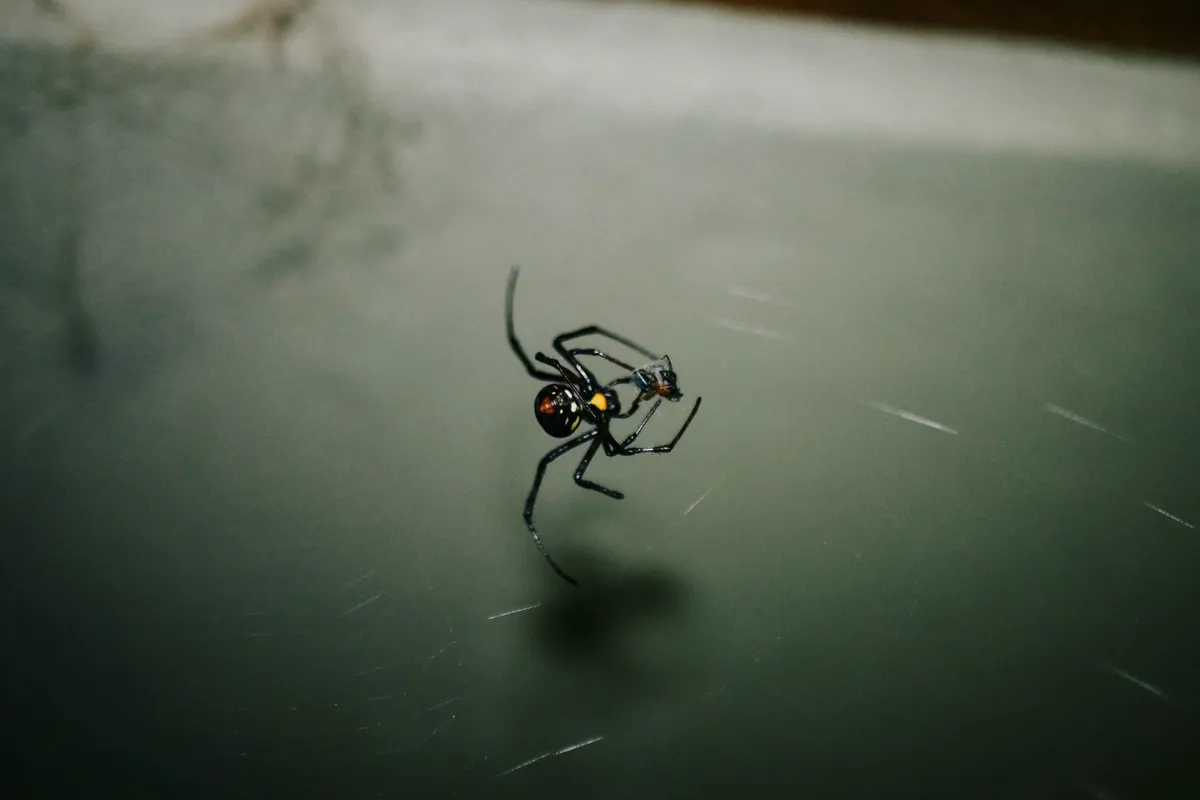
According to Texas A&M’s urban entomology page on the black widow spider, black widows are typically shy and retiring. People are bitten when they accidentally disturb a hidden spider or its web. Key features:
- typically jet black, although coloration may vary by species,
- two reddish triangles on the underside of the abdomen,
- eight eyes in two rows,
- eggs laid in a loosely woven cup of silk.
Around homes, the same page lists out-houses, garages, cellars, furniture, shrubbery, ventilators, rain spouts, gas and electric meters and other undisturbed places. In practice, that means reaching under outdoor furniture, into a meter box or behind stored items without looking first is how most encounters happen.
To check by phone whether a participating pest control company covers your ZIP code, call (888) 204-8144 and say which spider you think you have seen and where.
Brown recluse: how to recognize it and where it hides
AgriLife’s fact sheet on the brown recluse spider calls it one of the most dreaded household pests in Texas. It says a non-expert can identify it by looking for:
- a light brown to greyish spider with slender legs spanning roughly the size of a quarter to a half-dollar,
- a dark violin-shaped marking on the back of the front part of the body,
- six eyes arranged in pairs in a semicircle.
The brown recluse is shy, not naturally aggressive, and mostly active at night, when it comes out to hunt insects. It does not spend much time on webs. Indoors, AgriLife says it is most common in cluttered closets, garages, crawl spaces and attics, and frequently in and around boxes stored in closets and attics. Adults are most often seen in spring; the fact sheet says the mating season in Oklahoma, Arkansas and Texas runs from April to early July.

Black widow and brown recluse at a glance
| Black widow | Brown recluse | |
|---|---|---|
| Color | Typically jet black | Light brown to greyish |
| Key mark | Two reddish triangles under the abdomen | Dark violin shape on the front part of the body |
| Eyes | Eight, in two rows | Six, in pairs in a semicircle |
| Web | Builds webs in protected spots | Hunts at night; webs are inconspicuous |
| Typical hiding places | Garages, cellars, furniture, shrubbery, meters, rain spouts | Cluttered closets, garages, crawl spaces, attics, stored boxes |
Sources: Texas A&M urban entomology (black widow) and AgriLife Extension fact sheet ENT-3003 (brown recluse).
What a professional spider treatment involves
AgriLife describes a four-step, integrated approach for brown recluse spiders, and says a combination of insecticide and sanitation is usually required for a well-entrenched infestation. A professional plan should look something like this:
- Sanitation and trapping. Clutter is removed, webs are taken down inside and out, and the house is vacuumed around, under and behind furniture. Sticky cards placed along walls, in closets and under furniture remove some spiders and let you and the company track progress over time.
- Residual sprays. Liquid insecticide on the exterior foundation, eaves, edges of closets, storage areas and room perimeters where needed. AgriLife notes that the surface matters: in research, sprays on wood and masonite controlled spiders only up to seven days, while residues on some vinyl surfaces gave good control up to 60 days.
- Residual dusts. Dust in wall voids, attics and inaccessible crawl spaces, where sprays cannot reach. AgriLife does not generally recommend area-wide treatment of attics because of the risk of contaminating stored belongings and drift into living areas.
- Aerosol or ULV treatment, in limited cases. On its own it is not likely to control spiders, but it may help suppress their insect prey in attics and other inaccessible areas.
The same fact sheet points out that botanical extracts and oils may give short-term repellency but have not been tested against brown recluse spiders. Ask the company what it plans to use and why, and expect more than one visit for a heavy infestation. Its tips for professionals also mention research from Oklahoma State and Texas A&M showing that brown recluse spiders are difficult to kill with most insecticides.
How to prepare the house before the visit
AgriLife says clutter removal is best done before the pest control professional arrives. Useful steps:
- Clear floors of closets and the garage so baseboards and corners can be reached.
- Tape stored boxes tightly shut, or move items into sealed plastic bins.
- Shake out shoes, gloves and clothing that have been sitting in storage before using them.
- Make sure doors close tightly and shield outdoor lighting, which attracts the insects spiders feed on.
Sealing gaps around doors, windows and utility lines also cuts down on the insects that draw spiders in. Our guide to exclusion work for Texas homes explains what that involves, and our page on integrated pest management shows how inspection, prevention and treatment fit together.
If someone is bitten
Texas A&M describes black widow bites that can become systemic, with intense pain within 1 to 3 hours, and AgriLife says brown recluse bites can lead to skin ulcers and, rarely, life-threatening complications. Do not wait for an exterminator in that case: contact a doctor or poison control right away, and if you can do it safely, keep the spider or take a photo to help with identification.
Choosing a spider exterminator in Texas
Pest control for hire in Texas is licensed by the Texas Department of Agriculture. Our guide on checking a Texas pest control license shows how to look up the business and the technician. When you compare companies, ask:
- Will you inspect closets, the garage, the attic and crawl space, or only spray the perimeter?
- Which products will you use, on which surfaces, and how long should people and pets stay out of treated areas?
- Do you place sticky cards to measure results, and when is the follow-up visit?
If scorpions are also showing up, see our page on scorpion control in Texas, since the hiding places and the prevention work overlap.
Questions Texas homeowners ask
Can I get rid of brown recluse spiders myself?
AgriLife says the best solution to a household infestation is to hire a professional pest control company, and that even professionals find brown recluse infestations difficult to control. Clutter removal and sticky cards help, but they rarely solve the problem alone.
Why do I keep seeing spiders after a treatment?
Spiders follow their prey. AgriLife notes that many spiders in a building usually means insect prey is abundant, and that sprays on wood surfaces lasted only up to seven days in research. Reducing insects and clutter matters as much as the spray.
Where do black widows hide around a house?
Texas A&M lists garages, cellars, out-houses, furniture, shrubbery, ventilators, rain spouts and gas and electric meters, among other undisturbed places.
When are brown recluse spiders most active in Texas?
AgriLife says adults are most frequently seen in spring and that the mating season in Texas runs from April to early July. They hunt at night.
Sources read on November 13, 2026: Texas A&M AgriLife Extension, Brown Recluse Spider (ENT-3003, Michael Merchant); Texas A&M Urban Entomology, Black Widow Spider. General information, not medical advice.
Checking what is available in your area
texaspestcontrolpro.com is a connection service. We do not perform pest control and we do not employ technicians. When you call, a partner call service checks whether a participating local pest control company serves your ZIP code and connects you; we may be paid when you call. Availability varies by area and by season, and you decide whether to move forward with anyone you speak to.
To check by phone, call (888) 204-8144 and describe the spider you saw and the rooms where you keep finding them.